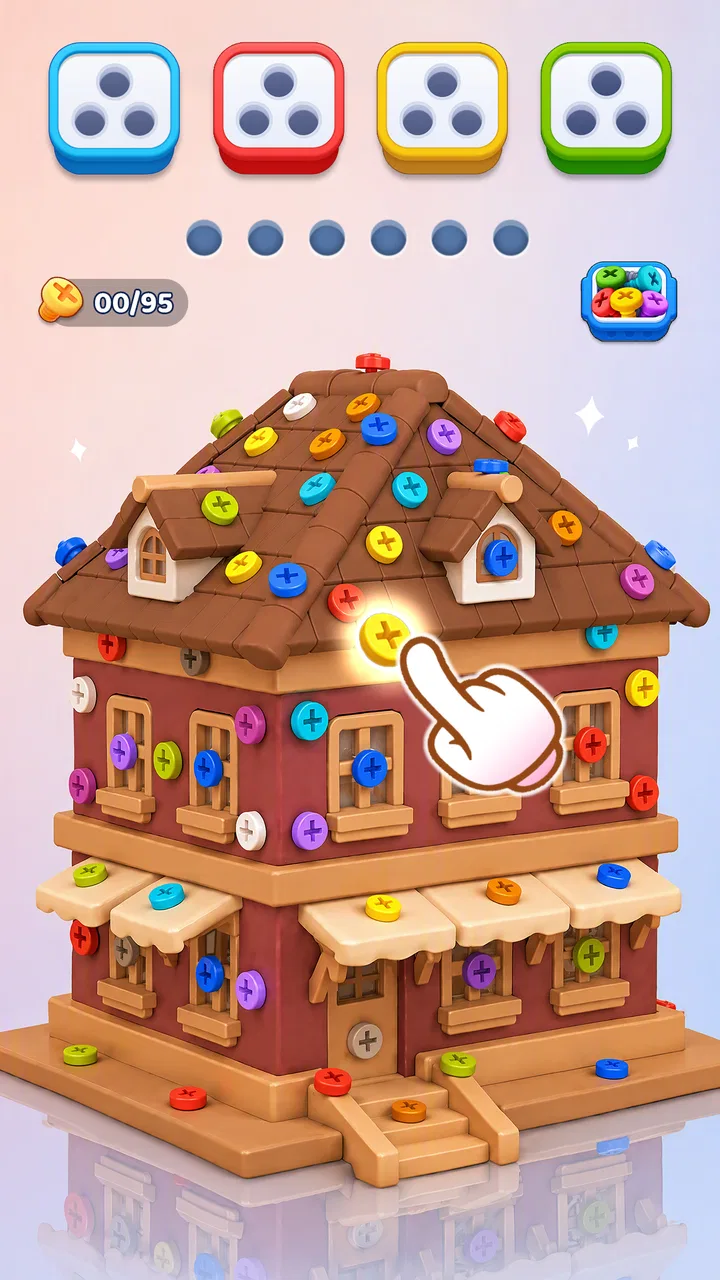
Unscrew Frenzy 3D
- 4.5
- Rating
- 1.00M
- Installs
- Free
- Price

 Analysis by App-foxy
Unscrew Frenzy 3D is a free puzzle game from Kiwi Fun that turns a crowded arrangement of screws, bolts, and pins into a hands-on sorting challenge. I found the basic idea easy to understand within moments: inspect the board, remove pieces in a safe order, and keep working until the jam is cleared. That simplicity makes it approachable for a first-time player, while the three-dimensional presentation gives each puzzle more visual depth than a flat matching game.
The game is listed in the puzzle category and is suitable for Everyone, so it is an easy recommendation for short sessions with no complicated setup. It has reached over one million installs and holds a 4.7 average from around twelve thousand ratings, which suggests that the central loop has connected with a sizeable audience. My impression is that its appeal comes less from a story or character system and more from the satisfaction of making a tangled object gradually come apart.
Getting comfortable with the board
When I begin a new puzzle, I do not immediately tap the most obvious screw. I first look at the whole arrangement and identify which pieces appear to be holding others in place. That small pause matters. In a game built around unscrewing pins and bolts, a move can be legal without being helpful, and removing the wrong piece may leave the board harder to read or reduce the room available for the next action.
You May Also Like

 Blood Strike: 2.5 Anniversary
Blood Strike’s Loadouts Turn Every Drop Into a Tactical Gamble
A close look at Blood Strike’s custom loadouts: how fast access to signature weapons reshapes its battle royale rhythm, rewards preparation, and narrows the gap between fights.

 Pandora - Music & Podcasts
Pandora’s Music Is Easy to Start, but Harder to Recover
Pandora’s strength is its low-effort path from a seed to a station. Its weak spot is how much confidence it asks you to place in connection, setup, and quiet recovery.

 8 Ball Pool
 Is Built on Rivalries, Rematches, and Routine
A close look at the rivalries, rematches, shared routines, and unanswered safety questions that turn a quick pool match into a persistent mobile community.

 Samsung Music
’s Quiet Strength Is Playing What You Already Own
Its reach comes less from spectacle than from dependable access to a personal library. That simplicity is both the app’s strongest retention engine and its ceiling.

 AccuWeather: Weather Radar
AccuWeather Review: A Quick, Clear Forecast for Everyday Decisions
For everyday plans, the best forecast is the one you can understand quickly. AccuWeather makes rain timing, radar, and local conditions easy to act on, with a few trade-offs.

 Hill Climb Racing
Why Hill Climb Racing Still Turns Crashes Into One More Run
A tiny car, a bumpy hill and one more upgrade: Hill Climb Racing keeps resurfacing because its simple chaos makes every near-miss feel personal.
More From Our News Desk



The best way to approach the opening screen is as a physical object rather than a conventional match-three grid. I look for visible connections, blocked spaces, and pieces that can be reached without disturbing several others. This makes the first meaningful success feel earned: instead of tapping randomly, I make a short plan, remove an obstructing part, and watch another section become accessible.
That first success is reassuring because the controls are not the difficult part. The real challenge is recognizing order. If you are used to puzzle games where every move immediately produces a reward, the slower inspection here may take a little adjustment. I enjoyed that change of pace, although players who prefer instant combinations or rapid timers may find the opening moments more deliberate than expected.
What the first session feels like
A useful first-session routine is to spend a few seconds rotating your attention around the board before making the first move. I mentally divide the puzzle into small clusters and choose one area that seems least crowded. After removing a piece, I pause again rather than tapping through a chain of guesses. This keeps the board readable and helps reveal whether the previous move created space or merely shifted the problem.
For a realistic everyday example, I can see this working well during a short break while waiting for an appointment or commuting. One puzzle can provide a focused activity without requiring a long story recap or a large time commitment. The visual task is engaging enough to pull attention away from idle scrolling, but it does not demand the same continuous concentration as a competitive action game.
The game is currently at version 2.0.8 and runs on Android devices using version 7.0 or later. That makes it accessible to people using older compatible phones, although the exact feel will still depend on screen size and performance. On a smaller display, crowded pieces can be more difficult to distinguish, so I would recommend playing with the phone held steadily and avoiding hurried taps when several parts overlap.
How to make the first clear move
My preferred opening method is to find a piece that blocks access to another part of the structure, then remove only that piece and reassess. I do not treat the first available target as automatically correct. A good move usually does one of three things: opens a previously hidden area, creates a safer route through the board, or reduces the number of pieces competing for the same space.
This approach also answers a question many new players have: should every move be planned several steps ahead? I do not think that is necessary at the beginning. Planning one or two moves ahead is enough to avoid careless choices, while trying to calculate the entire puzzle can make a simple board feel intimidating. The useful habit is to keep a flexible plan and update it after every removal.
When a section opens, I look for newly exposed fasteners rather than returning automatically to the original cluster. The board may now offer a better route. This is one of the more interesting trade-offs in the design: progress often comes from changing the shape of the problem, not from following a fixed sequence from corner to corner.
Where first-time players can get confused
The three-dimensional layout can make pieces appear closer or more available than they really are. A bolt that looks like the obvious target may be visually prominent but strategically unhelpful. I learned to distinguish between what I can see and what I can safely clear. That difference is small, yet it explains why random tapping quickly becomes frustrating.
Another common mistake is treating an empty space as permanent freedom. Opening one gap does not necessarily solve the surrounding cluster; it may simply reveal another obstruction. I use each new gap as a viewing window. Before acting again, I check whether it exposes a useful piece, a blocked route, or a chance to reduce congestion elsewhere.
Players may also wonder whether they should restart immediately after a poor move. I would not. A single imperfect action is often worth observing because it shows how the arrangement reacts. Restarting too quickly can prevent you from learning the board’s logic. I only consider starting over when my remaining options are clearly worse than the original position and continuing would become blind trial and error.
This is also where the game differs from many familiar casual puzzle alternatives. Match-based games usually emphasize color recognition, chain building, and quick reactions. Traditional sliding puzzles focus on a fixed grid and positional planning. Here, the main skill is spatial sequencing: deciding which fastener to remove so that the next useful action becomes possible. If you enjoy physical disentanglement puzzles, that distinction is a strong reason to try it. If you want colorful combos or a strong score-chasing rhythm, another puzzle style may suit you better.
Managing mistakes without losing the fun
I find the experience most enjoyable when I treat mistakes as information rather than failure. A bad move can reveal which parts are connected visually and which are merely layered in front. On a later attempt, I remember the obstruction and choose a different opening. This turns repetition into a small learning process instead of a sequence of guesses.
There is a practical reason to slow down as the board becomes more open. Early moves usually improve visibility, while later moves determine whether the remaining pieces can be handled cleanly. I save my most careful attention for the middle and end of a puzzle, when there are fewer distractions but each decision has more influence on the finish.
For a child or a family member trying it for the first time, I would explain the game using one simple rule: remove pieces that help reveal the next useful piece. That is clearer than telling them to tap whatever is easiest to reach. The Everyone age rating makes the game broadly approachable, but younger players may still benefit from guidance about patience and looking before touching.
Free access and the purchase question
The game is free to download, which makes it easy to test the core experience before deciding whether it belongs on your phone. In-app purchases range from $0.99 to $99.99 per item. Because of that wide range, I would approach optional spending deliberately rather than tapping through prompts automatically. A free starting point is valuable, but a player should still decide in advance whether they want to spend anything.
My advice is to play enough to understand whether the unscrewing loop itself is satisfying. If you enjoy examining the board, recovering from mistakes, and clearing a difficult arrangement, the game has already demonstrated its main value without requiring a purchase. If you dislike the central mechanic, spending more will not change the fact that the experience is built around spatial removal and jam-solving.
This is an important difference from games where the main attraction is a deep campaign or a large collection of modes. I would not choose this one expecting a substantial narrative journey. I choose it for focused puzzle sessions, tactile-looking boards, and the quiet satisfaction of turning a crowded structure into an empty one.
Who will get the most from it
I think it is a good fit for players who like sorting, mechanical objects, and puzzles that reward careful observation more than speed. It can also work for people who want something more involved than a basic time-killer but less demanding than a competitive game. The short-session format makes it convenient when I have only a few minutes and do not want to remember a complicated control scheme.
It is less suitable for someone who wants a clear long-term progression system, social competition, or constant novelty in the moment-to-moment action. The appeal depends heavily on enjoying the act of inspecting and dismantling. Players who become impatient when a puzzle requires a restart may also find the experience tiring, especially if they prefer games where every move can be corrected easily.
Compared with a standard logic puzzle, the three-dimensional presentation gives this game a more object-focused identity. Compared with a fast arcade puzzle, it feels calmer and more deliberate. That middle position is its strength, but it is also its limitation: it will not replace every type of puzzle game because it is designed around one particular kind of satisfaction.
A practical routine for harder boards
When a puzzle starts to feel crowded, I use a three-pass routine. First, I scan for pieces that are visibly isolated or easy to remove without affecting a useful route. Second, I identify the cluster that seems to control the most space. Third, I choose the move that improves visibility, even if it does not look like immediate progress. This keeps me from spending several turns on a small area while a larger obstruction remains untouched.
A second helpful habit is to remember the reason for each move. Instead of thinking, “I removed this because it was available,” I ask, “I removed this to expose the lower cluster.” If the board develops differently than expected, I can adjust intelligently. That simple mental note is especially useful when I return after a distraction and need to recover my plan.
I also avoid playing too quickly on a small screen. A finger can cover several nearby parts, and a rushed tap may make it harder to understand what changed. Holding the device closer, increasing attention to the visible layers, and pausing after each action are more useful than trying to increase speed. The game rewards clarity, not frantic input.
My overall recommendation
Kiwi Fun has built a focused puzzle game with a clear identity. Unscrew Frenzy 3D asks me to slow down, inspect a mechanical-looking arrangement, and create a path through it one careful removal at a time. The first successful clear is easy to understand, but the more satisfying moments come later, when a seemingly blocked board opens because of a well-chosen move.
I appreciate that the game can be started for free and understood without a long tutorial explanation. I also like that its main challenge remains readable: when I struggle, I usually know that I need to inspect the order more carefully rather than master complicated controls. The friction comes from the same place as the enjoyment, since a poor decision can make the board feel congested and may encourage repetition.
With a 4.7 average across around twelve thousand ratings, it has clearly found an audience, and I can understand why. The experience is especially convincing for short, quiet sessions where I want a puzzle that feels tactile and visual. I would recommend it to anyone who enjoys disentangling objects and planning a few moves ahead. I would skip it in favor of a match-based or competitive puzzle if my priority were speed, combos, or constant score pressure.
My best advice for a first-time player is to treat the opening as an inspection phase, not a race. Remove one piece that improves access, reassess the new shape, and keep choosing moves that make the next decision clearer. Once that rhythm clicks, the game becomes much more than tapping screws: it becomes a compact exercise in space, order, and controlled problem-solving.
FAQs for Unscrew Frenzy 3D
01What is Unscrew Frenzy 3D all about?
Unscrew Frenzy 3D is a thrilling puzzle game where players must strategically unscrew various objects to progress through increasingly challenging levels. The goal is to solve each puzzle by carefully determining the correct order and method to unscrew items, which requires both logic and precision. It's perfect for fans of brain-teasing games.
02Is Unscrew Frenzy 3D suitable for all age groups?
Yes, Unscrew Frenzy 3D is designed to be family-friendly and suitable for all age groups. The game features intuitive controls and a simple interface that make it easy for both kids and adults to enjoy. However, some of the puzzles can be quite challenging, making it more appealing to older children and adults who enjoy complex problem-solving.
03Does Unscrew Frenzy 3D require an internet connection?
No, Unscrew Frenzy 3D does not require an internet connection to play. Once downloaded, you can enjoy the game offline anytime, anywhere. This makes it a great option for traveling or when you want to play without worrying about data usage or connectivity issues.
04Are there in-app purchases in Unscrew Frenzy 3D?
Yes, Unscrew Frenzy 3D offers in-app purchases. While the game is free to download, players have the option to buy additional tools, hints, or cosmetics to enhance their gaming experience. These purchases are optional, and the game can be fully enjoyed without spending money, though it may require more time and effort to complete.
05What platforms is Unscrew Frenzy 3D available on?
Unscrew Frenzy 3D is available for download on both Android and iOS platforms. You can find it on the Google Play Store for Android devices and the Apple App Store for iOS devices. Ensure your device meets the app’s requirements for a smooth and enjoyable gaming experience.
Pros
- Engaging and addictive gameplay.
- Intuitive controls for easy play.
- Vibrant and colorful graphics.
- Regular updates with new levels.
- Offline mode available.
Cons
- Contains in-app purchases.
- May drain battery quickly.
- Ads can be intrusive.
- Limited customization options.
- Requires frequent updates.

Unscrew Frenzy 3D
Gallery